

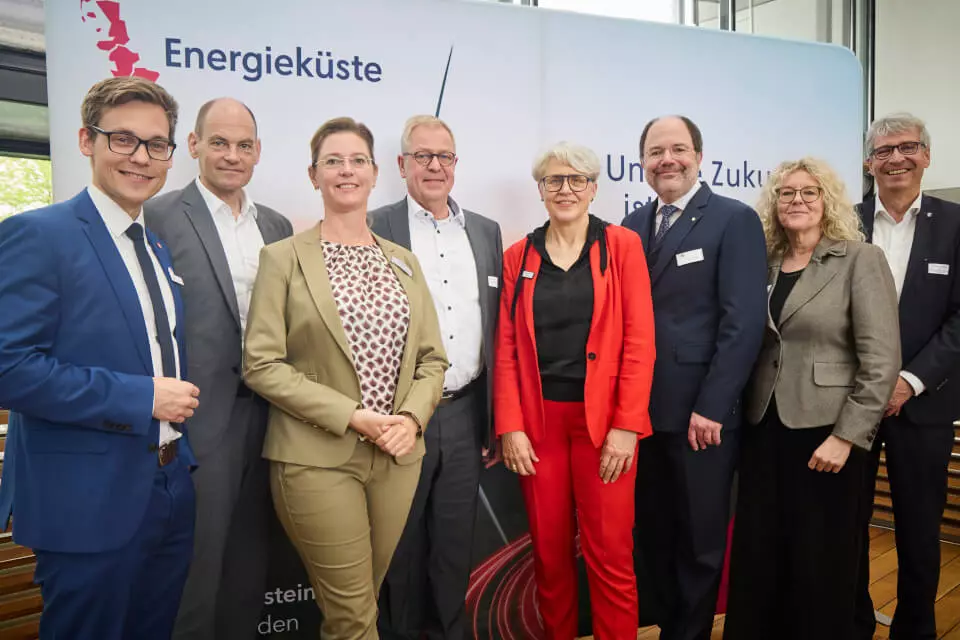
Recent study provides the federal government with a regionalised database
The west coast of Schleswig-Holstein is at the heart of a nationwide energy system based entirely on renewable energy. For years, the federal government has been announcing plans to invest in its traffic infrastructure on the west coast. Little has happened so far. “To make the energy transition a success, the region needs efficient and future-proof roads, as well as rail and waterways”, demands the chairman of the West Coast Regional Cooperation, Steinburg District Administrator Claudius Teske.
A recent business survey highlights the roles the west coast already fulfils today: The ports ensure energy and supply, tourism is a major economic factor, and the region forms a close link between Germany and Scandinavia. “To ensure these functions can be reliably fulfilled, including from the perspectives of geopolitical independence and defence, targeted investment in transport infrastructure is needed”, summarises Benno Bock, senior consultant at Ramboll Germany. The survey forms part of a transport economics analysis commissioned by the region from the planning consultancy. More than 400 businesses on the west coast took part in the survey this spring.
The Energieküste as a link in European transport flows
The importance of functioning transport routes for economic activity in the region is highlighted by an assessment from the economic development agency. “The Energieküste has developed into a central transport hub within Europe. We need solutions that meet the growing demands, because the energy transition cannot be achieved via village roads”, explains Roy Kühnast, business development officer at the Westholstein Development Agency and board member of the Schleswig-Holstein Logistics Initiative. The A20 motorway with a fixed Elbe crossing at Glückstadt and an upgrade of the B5 would be an effective complement to the A7. This is because the realisation of both infrastructure projects would make freight transport more efficient and resilient, and would open up development prospects for companies at the federal state's largest industrial site, the ChemCoast Park Brunsbüttel. “However, the B5 in particular has so far been unable to realise its full potential”, emphasises Kühnast.
A coordinated regional approach
For the area comprising the four districts of Nordfriesland, Dithmarschen, Steinburg and Pinneberg, the Regional Cooperation has consolidated its demands for the expansion of regionally significant transport infrastructure in a position paper. With a “West Coast Declaration”, the region reaffirmed its solidarity to the federal government in 2024, aiming for a stronger joint presence in Berlin. “Our goal is to present a united front to the federal and state governments in order to shift the focus more strongly onto the west coast. And we will continue to pursue this path consistently”, said Dithmarschen District Administrator Thorben Schütt.
The full results of the commissioned traffic analysis are due to be presented at the end of October 2026.
West Coast Regional Cooperation
The four districts of Dithmarschen, North Frisia, Pinneberg and Steinburg, the economic development agencies of these districts (Development Agency Westholstein, the WEP Development Agency of the District of Pinneberg, the Economic Development Agency North Frisia) and the Chambers of Industry and Commerce for Flensburg and Kiel joined forces in 2012 to form the “West Coast Regional Cooperation”. The aim of the cooperation is to strengthen the economic structure of the west coast region in the long term. The focus is on project-based cooperation in various fields of activity, including the development of commercial land. Since 2014, the regional management team based at Projektgesellschaft Norderelbe mbH has been running the cooperation’s office. The region markets itself under the umbrella brand “Energieküste”.
Further information on the topics and projects of the West Coast Regional Cooperation is available here.
Related links
> Further information on the West Coast Regional Cooperation
