

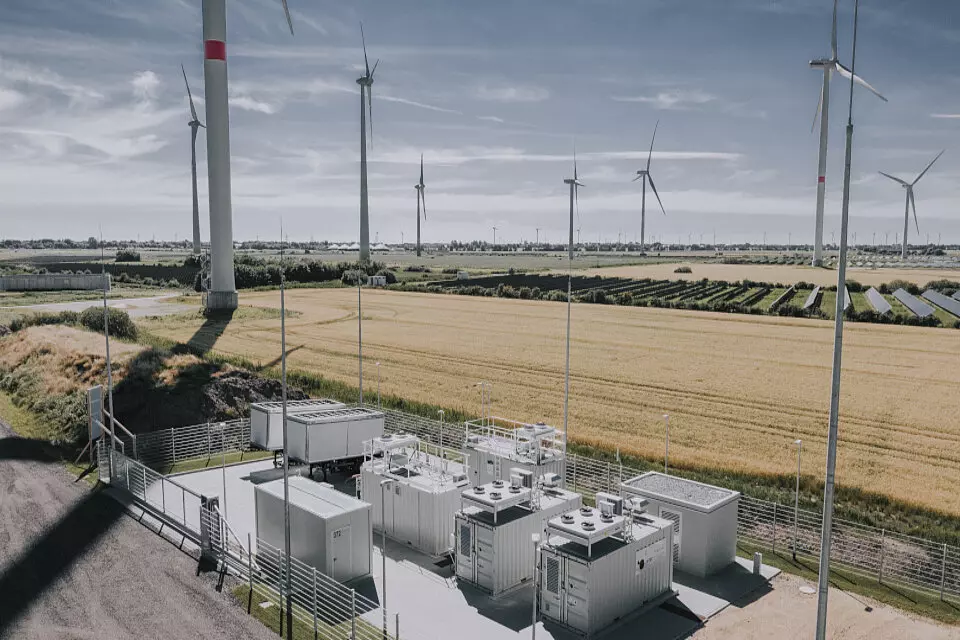
Regional data foundation established for potential hydrogen roll-out
The West Coast Regional Cooperation (umbrella brand: ‘Energieküste’) has presented a regional hydrogen strategy analysing the potential for regional production and consumption of green hydrogen up to the year 2040. The strategy was drawn up by the project development office H2Perform in Grömitz and shows that, thanks to its high supply of renewable energy, the west coast is well placed to develop a hydrogen economy: A high supply of renewable energy is combined with major industrial sites, suitable land, available water resources and a developing hydrogen infrastructure.
Converting local electricity into value creation
The first electrolysis projects are already in operation or at the planning stage. At the same time, the study shows that the region’s technical potential is significantly greater than previously assumed. The industrial sites at Brunsbüttel and Heide are highlighted as potential centres of demand for hydrogen. Potential for the production of sustainable fuels is also identified in the transport sector. The west coast could, for example, play an important role in the production of e-kerosene in future. A prerequisite for this is the establishment of appropriate production capacities on the west coast, so that the associated value creation takes place within the region.
Framework conditions as a decisive factor
At the same time, the study makes it clear that there is still a considerable gap between the technical possibilities and economic reality. ‘For the west coast, it is crucial to transform existing locational advantages into cost advantages through favourable framework conditions, so that hydrogen can be produced and sold. Land, water (wastewater) and green electricity are available in sufficient quantities,’ appealed Dr Kerstin Meyer of Regional Management West Coast. What would be crucial, however, are economically viable business models, reliable demand, the timely expansion of infrastructure and a stable regulatory framework in the long term. The years up to 2030 in particular are regarded as a significant phase for investment decisions and market ramp-up.
12 Recommendations for Policy-Makers
To ensure that this potential is translated into concrete projects and investments, the strategy sets out twelve measures aimed at policy-makers at state, federal and EU level. These include, amongst other things, examining the possibility of designating Schleswig-Holstein as a green electricity zone, establishing an interdepartmental coordination body for major projects at state level, developing an integrated water management concept, and setting up a regional hydrogen advisory board.
Net Zero Valley Schleswig-Holstein as an opportunity for the region
The findings of the strategy were already discussed at an expert panel organised by Energieküste and EE.SH on 22nd September 2026 at WindEnergy Hamburg, where the role of hydrogen as a key industry for the state’s economic development was examined. The focus was on how the planned Net Zero Valley Schleswig-Holstein can support the ramp-up of hydrogen on the west coast. In particular, the importance of planning certainty, accelerated approval procedures and competitive framework conditions for investment was emphasised.
Julius Basler-Meier, project manager and managing director of H2Perform, summarises: ‘The region must position itself as a production hub through publicity, awareness-raising and marketing, and highlight its favourable location conditions. The hydrogen strategy comes at just the right time, as implementing these measures is compatible with the designation of the Net Zero Valley.'
The full hydrogen strategy can be found here.
Background to the project
The hydrogen strategy was drawn up as part of the ‘RegioStrat West Coast Energy Competence Region’ project. The aim of the project is the sustainable, integrated development of the region with a target horizon of 2040. A Strategic Regional Development Concept (SREK) was drawn up as part of the project. This takes into account developments arising from the potential for large-scale business settlements and devises targeted measures. The project is managed by the District of Dithmarschen.
Funding
The West Coast Hydrogen Strategy is an implementation project arising from the ‘RegioStrat West Coast Energy Competence Region’ project and, as such, received financial support from the Federal Ministry for Housing, Urban Development and Construction (BMWSB) and the Federal Institute for Research on Building, Urban Affairs and Spatial Planning (BBSR), which is part of the Ministry. Through the federal programme ‘RegioStrat – Strategic Regional Development’, the BMWSB and the BBSR support regions that are actively addressing their region-specific challenges. The ‘RegioStrat West Coast Energy Competence Region’ project is one of 13 initiatives receiving €450,000 in funding from the BMWSB/BBSR during the pilot phase of the federal funding programme. The partners of the West Coast Regional Cooperation, as well as the Region Heide Development Agency, are contributing their own funds to the project financing in addition to the federal funding.
Contact and further information:
Projektgesellschaft Norderelbe mbH
Regionalmanagement Westküste
Dr Kerstin Meyer Tel. 04821/17 888-19
E-Mail: meyer@pg-norderelbe.de
Further information on the topics and projects of the West Coast Regional Cooperation is available at rk‑westküste.de.
West Coast Regional Cooperation
The four districts of Dithmarschen, North Frisia, Pinneberg and Steinburg, the economic development agencies of these districts (Entwicklungsgesellschaft Westholstein mbH, WEP Wirtschaftsförderungs- und Entwicklungsgesellschaft des Kreises Pinneberg mbH, Wirtschaftsförderungsgesellschaft Nordfriesland mbH) and the Chambers of Commerce and Industry in Flensburg and Kiel joined forces in 2012 to form the ‘West Coast Regional Cooperation’. The aim of the cooperation is to strengthen the economic structure of the West Coast region in a sustainable manner. The focus is on project-based collaboration across various areas of activity, including the development of commercial land. Since 2014, the regional management team, based at Projektgesellschaft Norderelbe mbH, has been running the cooperation’s administrative office.
The region markets itself under the umbrella brand ‘Energieküste’ (energiekueste.de).
